
Having trouble with understanding basic endgame ideas?
King and pawn endgames are tough, and even high level masters mess them up over the board.
If you can memorize some main ideas and positions, you’ll be able to find what to do in these positions.
You’ll start to see these ideas even when the board is flooded with other pieces still.
To help ensure you remember what to do in many endgames, check out some of these must know ideas.
- Opposition
- Trebuchet
- Triangulation
Table of Contents
Opposition: Distant, Diagonal, and Indirect (Virtual)
There are four types of opposition and each one can be simplified to regular opposition if both sides are given more moves.
According to Jeremy Silman, “in such opposition battles, you want to have an odd number of squares between the Kings with the other guy to move!“
How Opposition Works in Chess
Opposition occurs when the kings are separated by one square. If you can move and put one square directly between your king and your opponent’s king, you have the opposition.
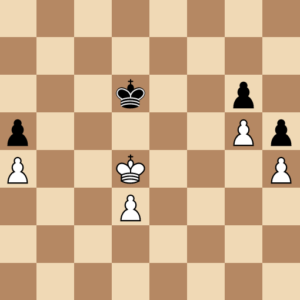
You can also think about opposition more easily by looking at the color square the kings are on. In this scenario, both kings are on dark squares so the opposition is easy to see.
The harder part is to understand when you will get to this position from far away. If we break it down into understanding the color square you’re on, distant opposition is easy to see.
Distant opposition
Distant opposition occurs when the kings are an odd number of squares away on the same file.
To easily find out who has the opposition, look at the color squares the kings are on.
If they are the same color and it is your opponent’s move, you have the opposition.

Distant opposition works on the same file, but to determine what to do if your opponent is on the same diagonal as you, we need to move on to diagonal opposition.
Diagonal Opposition
Diagonal opposition is the same as regular opposition, but the kings are one space away diagonally.
You can use it to your advantage in situations where you need to infiltrate a pawn weakness.

In this scenario black can play ke8, but white would maintain the opposition with ke6. If black moves to kd8, then white wins the pawn with kf7.
If black moves to kg8, white moves to kd7 and the black king slowly runs out of moves to protect the pawn’s promotion.
We can also see distant diagonal opposition if the kings are multiple files away from each other.

Indirect (or Virtual) Opposition
Since not every scenario will show both kings on the same files or diagonals, there needs to be another way to think through how to approach opposition.
You can also maintain the opposition with indirect opposition by making a rectangle.

The key here is to remember what we’ve learned so far.
To maintain opposition, you need to make sure your kings are on the same colored square with your move
You also need an odd number of squares between your kings.
In order to close the gap and maintain opposition, the correct move is ka2. Keep the diagram below in your mind.

White should try to force his way towards our other examples of opposition by the following means:
Ka2 Kf8 2. Kb2 Ke8 3. Kc2 Kf8 4. Kd2 Kg8 5. Ke2 Kh8 6. Kf2 Kh7 7. Kf3 Kh8 8. Kf4 Kg7 9. Kg5

Understanding the Trebuchet Technique
The trebuchet is a complicated position that arises in king and pawn endgames.
It is a form of Zugzwang in which you don’t want to be the player with the move.
The basic example looks like this:

When approaching the trebuchet, you need to carefully consider where not to move your king as you approach the pawns. Dvoretsky calls these mined squares in his endgame manual.
Consider this example, the squares highlighted are where the kings do not want to step.

If one king moves onto a mined square, the other king should occupy the other mined square on the next move to force diagram 2 above.
This results in a careful dance around these squares to win the position. If you can force your opponent to the mined square, you win the pawn and most likely the game, depending on the position.
Here’s a gif of black blundering the game by moving to a mined square.

Black must move his king after he moves to the mined square and there are no safe places to continue protecting the pawn on d5 so he must lose it.
Giving up a Turn with Triangulation
This is another king and pawn end game position.
Triangulation is often achieved when you have multiple squares to move to, but your opponent only has 2. You can then move your king 3 times while your opponent only has 2 moves. This results in “giving the move back to your opponent.”
We’ll show another example from Dvoretsky’s Endgame Manual.

White would love for it to be black’s move in this position.
However, in order to get black to move, the white king must make three moves and arrive at the same position. It would be played out as below:

This allows us to reach the original position with black to move instead. White then sacrifices the pawn once his king has reached a critical square and can support his own pawn.